Business teams chahte hain ke AI agents account data dekh saken, workflows trigger karen aur operators ko unhi systems mein madad dein jo employees pehle se use karte hain. Mushkil model nahi hai — CRM, ERP, ticketing aur internal APIs se connect karna hai bina fragile ad hoc integrations ke. Model Context Protocol (MCP) ek open protocol hai jo standardize karta hai ke AI applications external data sources aur tools se kaise connect hon. Enterprise leaders ke liye sawal yeh nahi ke MCP interesting hai — balke ke kya yeh governed production architecture mein fit hota hai.
Introduction
MCP businesses ke liye kaun sa masla hal karta hai? Zyada tar organizations ke paas APIs, SaaS platforms aur internal services pehle se hain. AI agents ko consistent, inspectable tareeqa chahiye context discover karne, tools invoke karne aur permission boundaries ke andar kaam karne ke liye. Standard connection layer ke baghair har agent project custom integration code dubara banata hai. MCP us layer ke liye shared model define karta hai.
Model Context Protocol (MCP) kya hai?
Model Context Protocol (MCP) ek open protocol hai jo LLM applications aur external data sources/tools ke darmiyan integration enable karta hai. Official specification MCP ko standardized tareeqa batati hai contextual information share karne, capabilities expose karne aur composable integrations banane ke liye.
MCP teen roles distinguish karta hai:
- Host — woh AI application jis se user interact karta hai.
- Client — host ke andar connector jo MCP server se connection maintain karta hai.
- Server — service jo protocol ke zariye business context aur capabilities host ko deti hai.
Communication JSON-RPC 2.0 messages use karti hai. Servers Resources, Prompts aur Tools expose kar sakte hain. Clients sampling offer kar sakte hain — achi implementations mein user approval ke sath.
MCP aap ka CRM, ERP ya databases replace nahi karta. Yeh AI host aur un adapters ke darmiyan connection standard hai jo un systems tak pohanchte hain.
Enterprise architecture mein MCP kaise kaam karta hai?
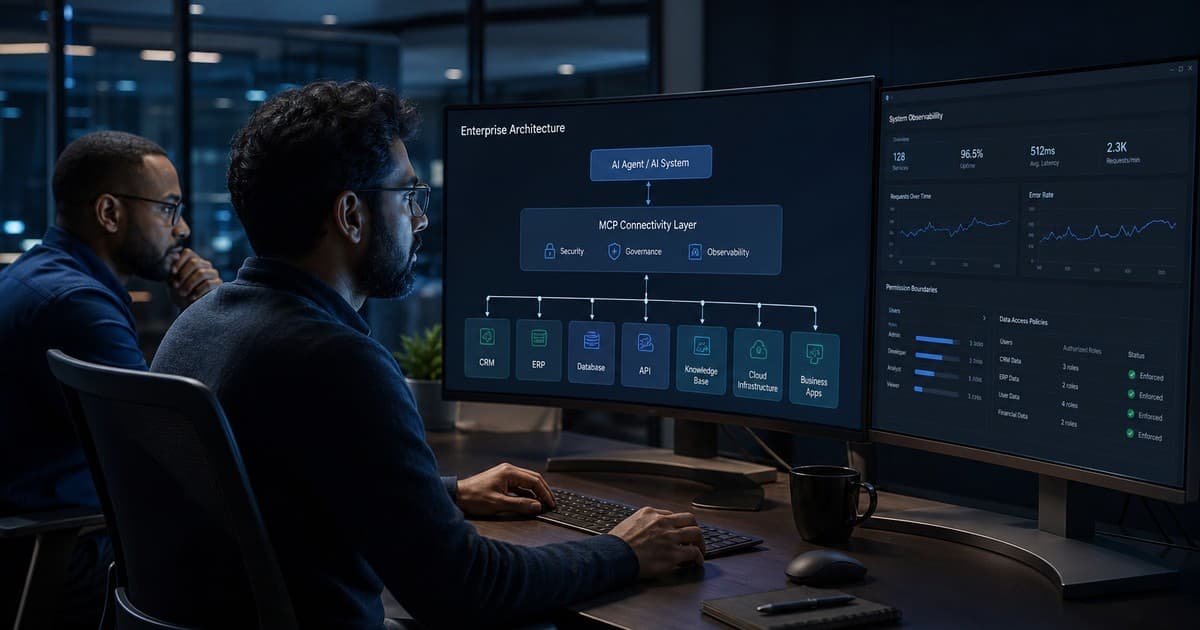
- Employee ya automated workflow approved host application mein AI agent trigger karta hai.
- MCP client ek ya zyada MCP servers se connect hota hai jo specific business domains tak limited hain.
- Har MCP server existing APIs, databases ya SaaS integrations ko consistent tool/resource interface ke peeche wrap karta hai.
- Host tools execute hone se pehle policy, logging aur approval rules apply karta hai.
- Results same channel se wapas aate hain — audit records enterprise platform par store hote hain.
AI agents ke liye MCP kyun matter karta hai
AI agents for business automation tab useful hote hain jab wo context retrieve kar ke multiple systems par act kar saken. MCP us boundary ko standardize karta hai:
- Tool discovery — capabilities consistent interface se enumerate
- Separation of concerns — domain teams MCP servers own karte hain; platform policy aur observability own karti hai
- Composable expansion — nayi capabilities servers ke tor par bina poori stack rewrite ke
- Vendor-neutral integration — MCP open protocol hai
MCP AI governance ya observability ki zaroorat khatam nahi karta.
MCP vs traditional API integration
| Dimension | Traditional API integration | MCP-based agent integration |
|---|---|---|
| Primary consumer | Application services, scripts, ETL | AI hosts aur agent runtimes |
| Interface style | REST, GraphQL, vendor SDKs | Standardized tools, resources, prompts via MCP |
| Discovery | Code ya internal docs mein | Runtime par host MCP se enumerate karta hai |
| Governance focus | Service accounts, scopes, rate limits | Tool consent, host policy, server authorization, audit |
| Best fit | Deterministic service-to-service workflows | Dynamic tool selection wale agent workflows |
| Risk profile | Correct scopes par well understood | Additional model risks (prompt injection, tool misuse) |
Kai production architectures dono use karti hain: conventional API integrations aur MCP servers agent-facing gateway ke tor par.
Enterprise use cases
CRM aur sales operations — account context, follow-up drafts; high-impact writes approval ke peeche.
Customer support — governed MCP servers se ticket summaries aur policy snippets.
ERP aur finance workflows — read-only lookups starting point; payment changes stricter controls ke sath.
Internal knowledge aur documents — approved repositories query; permissions source systems se match karein.
Software engineering aur data platforms — copilots repositories/catalogs se connected; production actions par tool safety critical.
Operations aur event-driven automation — queues, idempotency aur explicit audit ke sath.
Security aur governance risks
MCP specification warn karti hai ke protocol powerful capabilities enable karta hai — data access aur execution paths samet — aur implementers ko security carefully address karni chahiye:
- Prompt injection aur tool poisoning — tool descriptions untrusted unless trusted server se hon
- Over-permissioned tools — least privilege server aur identity layer par
- Weak consent — explicit user consent required
- Insufficient logging — AI observability optional nahi
- Legacy exposure — MCP neeche weak auth modernize nahi karta
- Token delegation issues — Enterprise-Managed Authorization (EMA) evaluate karein
Enterprise MCP security checklist
- Har MCP server ke tools/resources inventory karein
- Least privilege apply karein; read/write alag karein
- Explicit consent require karein
- High-impact actions ke liye human approval add karein
- Tool inputs schema se validate karein
- Tool metadata ko untrusted treat karein
- Identity centralize karein; EMA evaluate karein
- TLS aur secrets hygiene enforce karein
- Har tool invocation log karein
- Anomalies monitor karein
- Rollback plan — servers/tools quickly disable
- Failure modes test karein
Recommended production architecture
- Host policy layer
- MCP servers as adapters
- Identity aur authorization
- Approval workflow
- Observability pipeline
- Environment separation
- Change control aur versioned tool schemas
Business ko MCP kab use karna chahiye?
Jab zyada tar criteria apply hon: AI agents ko multiple systems ka dynamic access chahiye; multiple teams agent capabilities bana rahi hain; host policy aur domain integrations alag; governance, logging aur identity mein invest; runtime tool discovery se faida.
Jab MCP sahi choice na ho
Fully deterministic workflow; single API connection kaafi; regulatory constraints unsupported; legacy safely expose na ho sake.
Practical implementation roadmap
- Ek bounded workflow choose karein (read-only support context)
- Underlying APIs map karein
- Pilot MCP server read-only tools ke sath
- Host policy, consent, logging, approvals configure karein
- Red-team aur failure testing
- Tools gradually expand karein
- Operationalize — on-call, dashboards, versioning
AI agents vs agentic AI compare karte waqt same discipline apply karein.
FAQ
Kya MCP API replacement hai?
Nahi. MCP standardize karta hai ke AI hosts tools/resources se kaise connect hon; neeche servers conventional APIs call karte hain.
Kya MCP enterprise use ke liye secure enough hai?
MCP security principles define karta hai — enterprise security implementation par depend karti hai: least privilege, identity, logging, approvals, monitoring.
Business terms mein MCP server kya hai?
Controlled adapter jo approved business data/actions AI host ko standardized interface se expose karta hai.
Kya MCP AI agents ko CRM/ERP se connect kar sakta hai?
Haan, jab teams MCP servers banayein jo un APIs ko proper authorization ke sath wrap karein — adapters build aur govern karne padte hain.
Kya MCP legacy systems ke sath kaam karta hai?
Aksar haan adapters ke zariye — underlying system ki limitations apply rehti hain.
Businesses agent permissions kaise control karein?
Host policy, server authorization, corporate identity, role-based tool access aur human approval combine karein.
MCP ya conventional integration?
MCP jab AI host ko multiple tools ka standardized discoverable access chahiye; conventional jab deterministic point-to-point APIs kaafi hon.
Final thoughts
Model Context Protocol (MCP) enterprises ko practical standard deta hai AI agents ko un systems se connect karne ka jahan kaam actually hota hai. Clear permissions, explicit approvals, structured logging aur honest autonomous action scope ke sath maximum value milti hai.
Novapro Lab custom software platforms, SaaS systems aur automation infrastructure banata hai un teams ke liye jo production-ready results chahte hain — experiments nahi.
Need a software system like this?
Related articles

Enterprise AI کے لیے RAG: retrieval-augmented generation accuracy اور trust کیسے بہتر بناتا ہے
RAG AI models کو آپ کی company knowledge — policies، contracts، documentation، operational data — سے connect کرتا ہے تاکہ grounded، auditable، production-useful responses ملیں۔

AI Agents vs Agentic AI: فرق اور business میں کب کون سا approach استعمال کریں
AI agents اور Agentic AI related ہیں، لیکن same نہیں۔ جانیں ہر model کیسے کام کرتا ہے، deploy کب مناسب ہے، اور control کھوئے بغیر automation کیسے کریں۔
کاروباری خودکاری کے لیے AI گورننس: انسانی منظوری، audit trails، اور واضح قواعد کیوں اہم ہیں
AI خودکاری وقت بچا سکتی ہے اور آپریشنز بہتر بنا سکتی ہے، لیکن agents کو act کرنے سے پہلے businesses کو approval rules، audit trails، اور واضح boundaries درکار ہوتے ہیں۔